
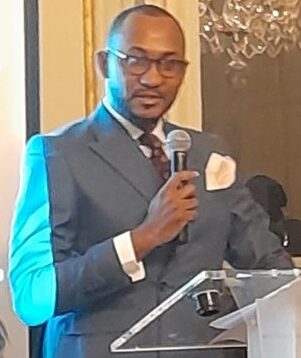

Speech by Pierre-Stanley PÉRONO, First Vice President, on the occasion of the CITI Centenary (November 30, 2023)
Speech on the Refounding of CITI
This speech on the Refounding of the International Council for Intellectual Transmission (CITI) was prepared by its then First Vice-President Pierre-Stanley PÉRONO during the presentations by the various speakers at the CITI Centenary Colloquium, and was delivered as a summary immediately after the speakers’ presentations at the Maison de l’Amérique Latine in Paris.
Here is the written transcript.
Ladies and gentlemen,
I have the distinct honor of summarizing the two round tables this evening, highlighting the contributions of these two round tables to CITI and its future.
Allow me to begin with what was not said, what was not contributed.
While taking notes earlier, as I had run out of space on my sheets of paper, my neighbor passed me this little notebook, in which I read a proposal that shows that promoting the rights of others is always promoting our own rights and allows us to progress with dignity.
I would like to share it with you: “Children’s rights make men grow.”
What contributions did this conference make to CITI and its future?
Listening to our speakers, I have heard words of hope.
For example, Mr. ZIELENSKI tells us that 74% of French people place a lot of trust in associations, even more than in local authorities. Mr. Laurent GREGOIRE also told us that the rate of global citizenship (citizenship towards the world) is 39%, compared to 10% or 12% for national citizenship.
But I have also heard words of concern.
Uninhibited violence, disorientation in our societies, increasing precariousness, legitimized violence, in the words of Mr. TRIBOT LA SPIERE. Mr. Jacques BREGEON talks to us about sustainable development, which brings not answers but questions, again and again.
Or the issue of the growing complexity of our problems, as raised by our Honorary President, Mr. Pierre-Julien DUBOST. Or my colleague Michelle JEAN-BAPTISTE, who talks about blood and sweat in the fight for ecological transformation.
How, then, can we not lose heart when faced with such a picture? How can we not give up?
Allow me to respond by talking about passion, or simply love, or even loyalty, which alone enable us to stay the course and fulfill our commitments in order to achieve the highest accomplishments, despite constant disruptions.
In this regard, “Nothing great has ever been accomplished in history without passion” explains Hegel in his Introduction to the Philosophy of History.
The passion that shapes history is not only hatred and the pursuit of personal gain, but also self-sacrifice in order to devote oneself to something greater than oneself, to great causes, “without knowing what the universe has in store for us, or even if it has a reward in store for us,” to quote Jean Jaurès.
What contribution does this symposium make to the new CITI and its future?
This symposium serves as a reminder to CITI of the importance and, above all, the urgency of this self-sacrifice that I have just mentioned, of this commitment of man to man in accordance with CITI’s new mission, which is now to promote intellectual transmission geared towards engagement with the major societal and environmental challenges of democracy and the rule of law in the 21st century.
This is no longer the CTI of a hundred years ago, it is no longer the Confederation of Intellectual Workers for whom we express our admiration, since for 100 years they have kept the torch burning so well that in reality we are but dwarfs perched on their shoulders of giants.
It is no longer the CTI defending the particular interests of a given category of workers, but the International Council for Intellectual Transmission, understood as a weapon in the service of broader political, economic, social, and environmental development, in line with the promises of democracy and human rights, understood in the broader context of the promise of a reconciled humanity.
Making CITI champion a cause that transcends it and that it can only champion through its resolutely international character in the ties it continues to forge with its partners within the Council of Europe, UNESCO, the International Labor Organization, and the World Intellectual Property Organization; but also now in Africa (I am thinking of RAPEC, the African Network of Cultural Promoters and Entrepreneurs, which is one of our partners; I am also thinking of Congo Brazzaville, namely the High Authority for the Fight Against Corruption, our partner; I am also thinking of Côte d’Ivoire with the High Patronage of Traders and Economic Operators of Côte d’Ivoire); but also today in Latin America because our Secretary General is the President of the Latin American Chamber of Commerce.
I am talking about the urgency of human commitment to humanity in the face of the current disruptions.
And I emphasize the words “urgency” and “commitment” much more than the disruptions themselves.
The reason for this is that almost all of history teaches us that political, economic, and social disruptions are permanent, and that it is often impossible to draw a line between what belongs to the past and what belongs to the future, between what belongs to the crisis and what belongs to the remedy.
Earlier, we talked about complexity—we talked about doubt, about that form of encirclement, sometimes cognitive or conceptual, that sometimes causes us to doubt the dangers or problems we face—the past or the future, the crisis or the remedy, often adorned with each other’s glitter and vice versa, in a frenzied dance of multiple intertwining and interlocking, in stretches from the past into the future, or in flashbacks, making breaks a powerfully perceptible element, as they are today, but one that is difficult to grasp.
So disruption is not the issue. The issue, as tonight’s speeches have clearly highlighted, is something much more specific, something exceptional today.
It is the feeling that we are currently at a crossroads of extreme intensification and amplification, unparalleled in these ruptures, which in turn creates a certain urgency to think and act.
I am talking of intensification, but above all of amplification, because while remaining repetitions or extensions of the past, these disruptions touch us deeply and in this sense they carry with them an almost new nature—that of the disruptions of our highest hopes, those great promises that the outline of a new world order seemed to give us legitimate reason to hope for.
The shattering of the hope that, after centuries of hard work, commitment, and struggle, humanity would finally succeed in maintaining the bond that peoples had worked so hard to build between democracies and human rights.
The shattering of the hope that, at the end of the Second World War, after the proclamations of new independences and then the end of the Cold War, this bond would never be broken.
The contributions to our two round tables serve to remind us, however, how much individual freedom, a certain idea of social justice and equality, security itself, and the most fundamental social rights (the right to justice, health, education, dignity) are being undermined by the resurgence of old scourges, which are reappearing in a far more dangerous form.
That is to say, a form that threatens to sever the very bond of trust between the governed and the governing, that threatens to destroy legitimacy, faith in the democratic model, and the struggle for human rights.
Trust, legitimacy, and faith that are yet so inseparable, so vital to the ongoing struggle to establish a fully liberated humanity.
Despite the apparent triumph of human rights, our entry into the 21st century has already reminded us many times of this disruption in our hopes, through the return of war, climate crises and economic predation, the struggle for control of resources, and above all the increasing complexity of the dangers that lie ahead.
And it is in this sense that this symposium, by drawing our attention to the urgency of thinking and acting, reminds CITI tonight of the full extent of these dangers and therefore of the urgency for human hope.
And at the same time, it reminds CITI how fully justified its recent transformation is.
A transformation towards intellectual transmission.
Intellectual transmission for sharing, transmission for openness, transmission for partnerships and the sharing of experiences, intellectual transmission for the proliferation of work in the areas of promotion, innovation, amplification, and exchange in the fields of development.
But also Intellectual Transmission in the specific sense of the term intellectual, understood as a new awareness and a new commitment to the world.
For what would Intellectual Transmission-Knowledge, Intellectual Transmission-Skills, Innovation, and Engineering in a complex world be, without Intellectual Transmission-Awareness, without Intellectual Transmission-Commitment?
It is desirable that CITI never loses sight of this second paradigm of Intellectual Transmission, which is Transmission from the Heart.
This Heart is the courage that allows us to stand up against everyone and against ourselves.
It is first and foremost the Courage to take the risk of wanting to work towards a new world that is fairer, more beautiful, and happier.
It is the courage to step outside one’s daily comfort zone to find the time and strength every day to pursue one’s daily bread, but at the same time to find the time to work for a cause that transcends us.
It is courage against oneself, it is the “courage of all courages” that I call Brotherhood and which is so admirably recalled in the Social Charter of Europe.
Intellectual Transmission is also, and above all, the transmission of this conscience, without which all science “is but the ruin of the soul.”
Pierre-Stanley PÉRONO
Pierre-Stanley PÉRONO is a business lawyer, registered with the Paris Bar, and an expert in economic intelligence and strategic management. He is the founding president of CABINET PÉRONO CONSEILS, where he works on lobbying, business law, project financing, and international trade cases. He is an economically and socially engaged actor in Europe, Africa, and Latin America on several levels, notably as a member of the Delegation of the Center for Strategic Studies and Forecasting to the Council of Europe, as a member of the Migration Issues Committee of the COING of the Council of Europe, as First Vice-President of the European Academy of Strasbourg, and as an expert on the list of experts of the Caribbean Chamber of Commerce in Europe.

